The recent medicinal products newsletter (issue 61) published by the HPRA includes an article about batch-specific requests (BSRs) and safety features. This is an update on the Falsified Medicines Directive safety features information.
The Commission Delegated Regulation (EU) 2016/161 with detailed rules for the safety features appearing on the packaging of medicinal products for human use, came into force in Ireland on the 9th February 2019.
BSRs will be considered for medicines for the Irish market that come within the scope of the regulation but do not bear safety features (UI and ATD).
The article outlines the details the MAH must provide in the BSR application.
Furthermore, the MAH must confirm that safety features have already been registered with the HPRA and if not a simultaneous Article 61 (3) notification must be submitted with the BSR application.
https://eureg.ie/wp-content/uploads/2019/03/FMD.jpg14411915ERAadministratorhttps://eureg.ie/wp-content/uploads/2023/10/European-Regulatory-Affairs-Logo.svgERAadministrator2019-03-25 17:17:252023-11-06 11:15:38HPRA update on Batch-specific requests for safety features
The Health Products Regulatory Authority (HPRA) of Ireland is geared up and ready to support MA holders as they prepare for Brexit.
What happens if UK leaves the EU with no deal?
The implications of Brexit with regard to the UK’s role in the licensing of medicines will be determined by the terms of the ongoing exit negotiations. However, in accordance with Directives 2001/82/EC and 2001/83/EC:
For marketing authorisations issued through the mutual recognition procedure (MRP) or decentralised procedure (DCP), the Reference Member State (RMS) must be based in the EU/EEA.
The marketing authorisation holder (MAH) must be located within the EU/EEA.
MAHs will need to ensure that their EU qualified person responsible for pharmacovigilance (QPPV) and their pharmacovigilance system master file (PSMF) are located within the EU/EEA.
The batch release/testing site must be located within the EU/EEA.
HPRA are working “extraordinarily” hard on preparing for all scenarios
HPRA are Brexit ready
– Willing to act as RMS for all products where Ireland (IE) is currently CMS and a change of RMS is required. No fees will apply to the process for changing RMS to IE. The HPRA commits to an efficient and simple process for handling these requests (for example allowing the inclusion of multiple products in one request where applicable).
– To encourage the use of multilingual labelling the HPRA will proactively work with other European regulators to help optimise opportunities for multilingual labelling. The HPRA ‘Guide to labels and leaflets of Human Medicines’ has been updated (Oct 2018) to give specific guidance on the development of multilingual labelling
– HPRA MAH transfer procedures have recently been changed to allow MAHs up to 6 months to implement packaging changes following issue of the transferred authorisation, for Brexit related transfers. In addition the HPRA no longer requires stock to be recalled from wholesaler level six months following the issue of the transferred authorisation/ licence/registration.
Timeline for changing RMS
Can be completed within a matter of days. The critical issue will be the timing of when the change in RMS should occur as it is required to occur when there are no open regulatory activities for a product.
Procedures for MAHs to transfer MAH to EU/EEA based MAH
The transfer procedure must be used where the legal entity of an authorisation/licence holder is changed as marketing authorisations are transferred to a new company number. It is possible to transfer the MAH while there are ongoing/open variations. If the transfer is processed/issued, the new MA holder details will transfer onto the open/ongoing variations
Bulk transfers are accepted by the HPRA for Brexit and reduced fees apply.
New PA number is provided in advance of application.
Word version of an updated package leaflet is acceptable.
If the only changes proposed relate to MAH details and a new PA number, an Article 61(3) application is not required. However, if there are additional changes to the labels and package leaflet an Article 61(3) application must be submitted. This can be submitted in parallel to the transfer.
Medical devices containing an ancillary medicinal substance
Transfers of medical devices containing a medicinal ancillary substance with a valid CE certificate are considered administrative only. Transfers typically take less than 30 days from validation of the submission to be completed. No fees will apply to this transfer process.
Parallel Product Authorisations
If the UK is listed as one of a number of source countries on a PPA, this will need to be removed by way of a type IA variation (category 4).
Where the holder of PPA is located within the UK, the authorisation will need to be transferred to holder located within the EEA.
Qualified person certification of repackaging activity must take place within the EEA. Variations to change the site of batch certification can be submitted using the PPA variation category No 9a and 9b.
Variations to Marketing Authorisations to change Qualified Person Responsible for Pharmacovigilance (QPPV), manufacturing site or/and batch release sites.
Any variations required for a marketing authorisation (MA), e.g change in location of QPPV or site of batch release, should be completed prior to the date of the UK’s departure from the EU (prior to the 29 March 2019).
Changes in the QPPV, including contact details (telephone, and fax numbers, postal address and email address) may, for medicinal products for human use, be updated through the Article 57 database only (without the need for a variation)
Changes to the location of the PSMF (street, city, postcode, country) may be updated through the Article 57 database only (without the need for a variation)
Are you in search of advice and support on Brexit?
Please contact us, Ivowen are available to offer advice and support on HPRA compliance.
Written by Nanda Naik
https://eureg.ie/wp-content/uploads/2018/11/IE-EU-flag.jpg285390ERAadministratorhttps://eureg.ie/wp-content/uploads/2023/10/European-Regulatory-Affairs-Logo.svgERAadministrator2018-11-21 16:10:012023-11-06 11:08:42HPRA’s support as you prepare for Brexit……
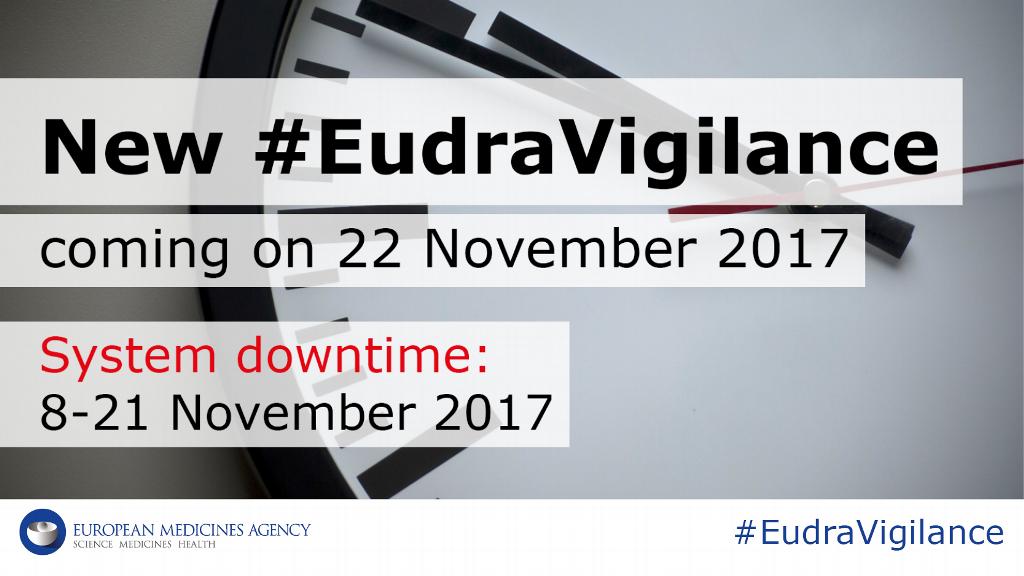
With the launch of the improved EudraVigilance (EV) System, and the move to the simplified reporting of adverse reaction reports (ADRs) on 22nd November 2017, Marketing Authorisation Holders and EV users in Ireland must familiarise themselves with the HPRA’s national arrangements that will be in place during the changeover period.
As of 4th November the HPRA closed its reporting gateway and MAH’s must not submit ICSRs/SUSARs to HPRA from this time, as all submissions will be lost upon go-live date (22nd November) in the system (EudraVigilance Go-Live Plan).
To facilitate EV users, there will be a 3-day ‘cutover legacy’ period from 22nd – 24th November when all ‘backlog’ ICSRs can be submitted to EudraVigilance with Compliance timelines adjusted to reflect the downtime during this period.
Any SUSARs sent to EVCTM from 4th to 7th November should be submitted to HPRA after 22nd November along with the other cutover legacy SUSARs. Sponsors and investigators are also obliged to notify the HPRA within 3 days of any action needed to protect the health and safety of clinical trial subjects, in accordance with the HPRA Guide to clinical trial applications
New Simplified reporting of Adverse Reaction Reports
From 22nd November all serious ICSRs that occur within or outside the EU will be reportable directly to EudraVigilance and no longer to individual National Competent Authorities (NCAs)/ Marketing Authorisation Holders (MAHs).
All reporting shall be in line with the final reporting arrangements as described in Directive 2001/83/EC as amended. Therefore all serious and non-serious ICSRs that occur in Ireland will be reportable directly to EudraVigilance by the MAH and not to the HPRA.
A key aspect of the new EudraVigilance system is its compatibility with the E2B(R3) format. Stakeholders may submit and receive ICSRs and SUSARs in the E2B(R3) format from 22nd November 2017 onwards, if their internal systems have been updated to meet this requirement.
For MAH EVWEB users any reports will automatically be generated in the E2B(R3) format and so it is recommended that these MAHs undergo training on EVWEB and the new ICH E2B(R3) format to gain familiarity with new functionalities and changes as there will be a new interface and improved functionalities.
We can help
Ivowen are fully equipped to advise and assist during this changeover period and beyond. Please see our Pharmacovigilance services page or contact us for more information.
Written by:
Edel Behan
https://eureg.ie/wp-content/uploads/2017/11/2017-11-EV-News-image.jpg5761024ERAadministratorhttps://eureg.ie/wp-content/uploads/2023/10/European-Regulatory-Affairs-Logo.svgERAadministrator2017-11-15 12:32:282023-11-06 11:12:35Launch of the new EudraVigilance System – National arrangements for Ireland and what this means for you
Updated “Guidance on good manufacturing practice and good distribution practice: Questions and answers”
Question on ‘What are the requirements for batch numbers appearing on the packaging of medicinal products subject to parallel trade?‘ updated in section ‘EU GMP guide part I: Basic requirements for medicinal products: Chapter 5: Production’
Updated guidance on “How to prepare and review a summary of product characteristics”
section on ‘Guidance for assessors’ updated.
Medicines – Veterinary:
Updated guidance on “Pre-authorisation guidance under the Veterinary Medicinal Products Regulation (Regulation (EU) 2019/6)”. Questions updated:
what is the procedure for establishment of maximum residue limits (MRLs)?
updated requirements for labelling for Finland & Greece & updated requirement for PIL for Finland
Updated “Request for MRP/RUP Template” to request an Assessment Report from RMS to include updated clarifications that:
the ERA provided in Module 1.6 should be up to date
if the ASMF/DMF or CEP has been superseded by a new version, a variation is to be filed prior to the MRP/RUP
Updated form on “Request for RMS in a decentralised procedure for medicinal products for human use” including multiple changes
Updated “Data requested for Variations and/or Renewal Applications in the MRP/DCP which are not stated in the current EU legislation and/or in Volume 2B, Presentation and format of the dossier Common Technical Document (CTD) and/or in the EEA approved Guidelines/ Recommendation papers”
clearly highlights which are the validation issues (preventing the procedure start and the non-validation issues (not preventing procedure start)
Updated “Data requested for New Applications in the MRP/DCP which are not stated in the current EU legislation and/or in Volume 2B, Presentation and format of the dossier Common Technical Document (CTD) and/or in the EEA approved Guidelines/Recommendation papers”
clearly highlights which are the validation issues (preventing the procedure start and the non-validation issues (not preventing procedure start)
Updated guidance on “Validation of MR/Repeat use/DC procedures”
updated to empower the RMS to start the procedure, in the exceptional case where CMSs do not react to validation responses within a given timeframe
Updated “CMDh Recommendation for classification of unforeseen variations according to Article 5 of Commission Regulation (EC) No 1234/2008, as amended”
deletion of a batch size of the finished product” can be submitted as a type IA variation under Q.II.b.4.z (certain conditions apply)
Updated PLM Portal eAF Release notes now available
An updated version of the PLM Portal eAF Release notes reflecting bug fixes and updates to web eAF made in the versions 1.2.1.21 (released to production on 13 October) and 2.1.22 (released to production on 26 October 2026) is now available on the PLM portal and eSubmission PLM Portal eAF.
Marketing authorisation application and Variation electronic application forms (eAF) for centrally authorised products – naming convention reminder
Applicants and Marketing Authorisation Holders (MAHs) are reminded that the prescribed naming convention for electronic application forms (eAFs) must be followed. Compliance with this convention enables the correct identification of eAF files within submission sequences received by EMA and supports their automated processing.
For human medicinal products, the applicable naming convention for marketing authorisation applications (MAAs) and Variations is described in:
eCTD 3.2.2 – EU Module 1 Implementation Guide (v3.1.1, page 34); and
The corresponding validation criteria, specifically the worksheet “File-folder structure and names.”
For veterinary marketing authorisation application (MAA) submissions to EMA, the electronic Application Form (Vet MAA interactive PDF eAF) included in the VNeeS package must also follow a specific naming convention. The filename must contain the text “ema-form-eaf”. Additional elements may be included in the filename, provided that the string “ema-form-eaf” remains present. Important:
The string “ema-form-eaf” must be used only for the MAA or Variation eAFs.
No other file within the submission package should contain “ema-form-eaf” in its filename.
EMA’s internal systems (IRIS) identify the eAF through an automated search for the string “ema-form-eaf”. If the naming convention is not followed, the system may be unable to correctly identify the eAF, which could affect processing.
As part of the validation process, submissions will be checked for compliance with this requirement. Where the naming convention has not been respected, applicants may be requested to resubmit the package with the correct filename.
Applicants are therefore strongly encouraged to verify the eAF filename before submission to avoid validation issues and potential processing delays.
For any support you might need to navigate the latest guidance or just for assistance with your EU and UK procedure preparations, submissions, responses, etc., you can contact us on info@eureg.ie
Written by
Marian Winder
Marian Winder 1
https://eureg.ie/wp-content/uploads/2026/01/1.Feature-image-Regulatory-Guidance-Updates-08-01-25.png10241536ERAadministratorhttps://eureg.ie/wp-content/uploads/2023/10/European-Regulatory-Affairs-Logo.svgERAadministrator2026-11-12 13:35:082026-11-12 13:35:08Regulatory Guidance updates October – 10th to 31st October 2026