Regulatory Guidance updates in August 2026


Title:  Regulatory Guidance updates in August 2026.

Body text:

Regulatory Guidance updates in August 2026 – ERA have tracked them for you!

HPRA (IE): 

  • Updated HPRA Guide to the Clinical Trials Regulation
    • to reflect the full implementation of the Clinical Trials Regulation (CTR)
    • to align with current European and national guidance and best practices
    • updated to requirements and timelines for submitting notifications and trial results.

MHRA (UK): 

  • Updated guidance on “Guidance on pharmacovigilance procedures”
    • Added further information on EURD list under section 5.2 of guidance

EMA (EU wide):

As always the EMA regularly updates their website – here are some of the highlights from August 2026.

Medicines – Human: 

  • Fees for human medicines updated:
    • Information about which fee reducations are applicable has been updated. Questions 1.2., 2.2., 4.2., 5.2., 6.1., 13.2 and 14.1. have been updated accordingly. Updated “European Medicines Agency pre-authorisation procedural advice for users of the centralised procedure”
    • To include reference to “Further guidance on the use of the IRIS platform and how to prepare submissions is available on the dedicated IRIS website” in section 1.7.2
    • Remove reference in section 2.1.23 to “Eligibility requests should be submitted via EMA Service Desk, selecting the tab “Business Services”, category “Human Regulatory”
    • Section 2.2 is updated to include” the applicants should use the IRIS platform when applying for eligibility, selecting submission type “Eligibility and letter of intent”. Annex 1 (draft Summary of Product Characteristics) and Annex 2 (Justification for Eligibility) must be included in the request
    • Eligibility request should no longer be submitted via EMA Service Desk
    • Section 2.7 is updated in include “Applicants should use the IRIS platform when the previously indicated submission date of an upcoming application for marketing authorisation is changed, selecting submission type “Notification of changes”.
  •  
  • Reliance for post-authorisation changes: guidance for the pharmaceutical industry
    • EMA makes available guidance on how pharmaceutical companies can apply to a pilot programme that enables them to use reliance to submit post-authorisation changes simultaneously to multiple countries outside the European Union.

Medicines – Veterinary: 

  • Fees for Veterinary medicines updated:
    • Questions 1.2., 3.2., 4.2., 6.2., 11.2., 11.3. have been updated with information on fee reductions
  • Updated Marketing authorisation (veterinary medicines)
    • Steps involved in obtaining an EU marketing authorisationupdated to reflect the migration of veterinary regulatory business services from ServiceNow to the IRIS platform.
  • Updated Verterinary medicines marketing authorisation application pre-submission interaction request form
  • Updated Pre-authorisation guidance under the Veterinary Medicinal Products Regulation (Regulation (EU) 2019/6); Questions updated:
    • Is my veterinary medicinal product eligible for evaluation under the centralised procedure?
    • How and when should the request for eligibility for the centralised procedure be sent to the European Medicines Agency?
    • What is the procedure for appointment of CVMP rapporteurs/co-rapporteurs and their assessment teams?
    • In which cases is my veterinary medicinal product eligible for an accelerated review?
    • How is a pre-submission interaction conducted at the EMA?

Upcoming Webinars: 

    • EMA risk management information day: 8th September 2026

 CMDh (MRP/DCP):

  • Update to “Guidance published by Member States on the implementation of the Falsified Medicines Directive”

eSubmissions:

Human Variation interactive PDF eAF v1.28.1.0 version available

  • Minor version 28.0.0of the interactive PDF electronic application form (eAF) for human marketing authorisation application is available on the eAF website.
    • The new version brings a minor change, affecting the substances dropdown in section 2.6.1.
      • The previously published version 1.28.0.0 should be exported and re-imported in the newly published PDF. The steps are explained in the following guidance, page 10: Technical User Guide for eAF.pdf.
      • Reminder:all the new form that are published need to ‘Trusted’. Follow the Practical user guide for electronic Application Forms (eAF) for human and veterinary products in the EU, page 11
      • For the implementation timeline of the 1.28.0.0 MAA forms, please consult the news from 30 June.Veterinary marketing authorisation application (MAA) form naming for Centrally Authorised Products (CAPs)
      • To support the automated processing of CAP(centrally authorised products) Veterinary marketing authorisation application (MAA) submissions at EMA, the electronic Application Form (Vet MAA interactive PDF eAF) included in the VNeeS package must follow a specific file naming convention. The eAF filename must contain the text: ema-form-eaf. Additional information may be included in the filename, provided that the string ema-form-eaf remains present.
      • Examples of acceptable filenames:
        • ema-form-eaf.pdf
        • ProductName_ema-form-eaf.pdf
        • ema-form-eaf_ProductName_v1.pdf

      Please note:

      • The text ema-form-eaf should be used only for the MAA eAF file.
      • No other file within the submission package should contain ema-form-eaf in its filename.

      EMA internal systems (IRIS) identify the eAF through an automated search for the string ema-form-eaf. If the naming convention is not respected, the system may be unable to identify the eAF correctly. As part of validation, submissions will be checked for compliance with this requirement. Where the naming convention has not been followed, applicants may be requested to resubmit the package with the correct filename.

      Applicants are therefore encouraged to verify the eAF filename before submission to avoid validation issues and potential delays in processing.

      Veterinary MAA eAF v1.28.0.0 – minor version available

      • Minor version 28.0.0of the interactive PDF electronic application form (eAF) for veterinary marketing authorisation application is available on the eAF website.
      • The new version brings a minor change, affecting the list of member states for sections 2.4.1 and 2.4.4 (UK(NI) is now included).
      • The previously published version 1.28.0.0 should be exported and re-imported in the newly published PDF. The steps are explained in the following guidance, page 10: Technical User Guide for eAF.pdf.
      • Reminder:all the new form that are published need to ‘Trusted’. Follow the Practical user guide for electronic Application Forms (eAF) for human and veterinary products in the EU, page 11.
      • For the implementation timeline of the 1.28.0.0 MAA Veterinary forms, please consult the news from 30 June.

      Updated PLM Portal eAF Release notes now available

      • An updated version of the PLM Portal eAF Release notes reflecting bug fixes and updates to web eAF made in the version 1.2.1.17 released to production on 18 August 2026 is now available on the PLM Portal and esubmission PLM Portal eAF
      • Reminder: mandatory use of PLM web-based eAF for CAPs – 1 September 2026
      • As announced in April 2026, the European Medicines Agency (EMA) is introducing the mandatory use for CAPs as of 1 September 2026. From 1 September date onwards, any human CAP variation submissions sent to EMA using the interactive PDF eAF will be rejected unless it is accompanied by a valid and justified technical reason preventing the use of the PLM web-based eAF (users are encouraged to review the full announcement made on 13 April 2026)
      • Before 1 September 2026, PLM portal eAF users should:

                        – Verify PMS data accuracy

                       – Ensure all users have the correct PLM Portal access and roles

                      –  Familiarise themselves with the PLM web-based eAF and available guidance materials

       – Practice creating submissions in the PLM portal. Draft forms  can be created and deactivated if not submitted.

      • Interactive PDF eAF may still be used for:
        • Large applications (over ~200 medicinal products) due to current performance limitations.
        • Medical Devices section issues.
        • Known PMS or OMS data issues affecting form completion.
        • Lack of PLM portal access or co-authoring capabilities.
        • Other technical issues that prevent timely completion of the PLM web-based eAF
      • Additional guidance:
        • Report resolvable issues through the EMA Service Desk: https://support.ema.europa.eu/esc
        • Use the interactive PDF eAF if issue resolution or service desk response times risk missing submission deadlines.
        • No service desk ticket is required for known limitations such as large applications, Medical Devices issues, or lack of PLM portal access.
      • To justify the use of the interactive eAF PDF, a new radio button will be introduced in the Delivery File User Interface (eSubmissions preparation) on 12 August 2026, after 18:00 CET. It is mandatory to confirm the use of the PLM portal eAF for all human variations (Type IA, Type IAIN, Type IB and Type II), for “Initial” and “Validation response” submission units.


      For any support you might need to navigate the latest guidance or just for assistance with your EU and UK procedure preparations, submissions, responses, etc., you can contact us on info@eureg.ie

      Written by

      Marian Winder 1

      Marian Winder 1

Regulatory Guidance updates in July 2026

Regulatory Guidance updates in July 2026 – ERA have tracked them for you!

HPRA (IE): 

  • The SoHO Regulation: all you need to know to get started guideline was published by the HPRA
    • Are you involved in activities concerning Substances of Human Origin (SoHO) intended for human applications?
    • Are you a facility where SoHO are applied to patients such as clinics, sport clinics, dentists, gynaecologists, ophthalmologists and any organisation using or processing SoHO?
    • Are you planning to commence SoHO-related activities?
    • If so, the new SoHO Regulation 2024/1938 shall apply to you as of 7 August 2027
  • The Guide to Fees for Veterinary Products has been updated
  • Labelling requirements for cosmetic products containing fragrances covered under Regulation (EU) 2023/1545
    • The HPRA has published a new information page to help members of the cosmetics industry comply with the fragrance allergen labelling requirements introduced under Regulation (EU) 2023/1545.
  • Guidance on controlled drugs requirements, this updated document follows a targeted consultation held in February 2026 including:
    • Electronic registers
    • Background checks for personnel
    • Transportation of controlled drugs
    • Clarification on the definitions of ‘Operator’ and ‘Responsible Officer’
  • HPRA to support EU Council Presidency
    • The HPRA will actively contribute to Ireland’s Presidency of the Council of the European Union from July to December 2026

MHRA (UK): 

  • Updated guidance on “Variations to marketing authorisations (MAs)”
    • Added section ‘Deadlines for new therapeutic indication variations’ to the section ‘Variations to add a new therapeutic indication’
  • Updated guidance on Clinical trials for medicines: ending a clinical trial.
    • Clarified requirements and links to additional guidance for submission of results where the trial is sponsored by the holder of a UK marketing authorisation and involves the use of that authorised medicinal product use in a paediatric population
  • Updated guidance on “Best practice in the labelling and packaging of medicines”
  • Updated guidance on ‘Best practice guidance on patient information leaflets’
  • Updated guidance on “Register to make submissions to the MHRA”
    • to change wording from ‘substantial amendments’ to ‘substantial modifications’ in text
  • Updated guidance “Register medical devices to place on the market”
    • To add clarification concerning devices put into service only.
    • This update provides a link to a new guidance document on ‘Registration of medical devices Guidance on the registration requirements for medical devices placed on the market and put into service’

EMA (EU wide):

As always the EMA regularly updates their website – here are some of the highlights from July 2026.

Medicines – Human: 

  • The presence of a Cover Letter is optional to use as from the 1st July 2026 for Type IA/IAIN variations for applications submitted via the Centralised procedure.
  • The following guideline has been amended as a result of this change:
    • European Medicines Agency post-authorisation procedural advice for users of the centralised procedure
    • Questions and answers: Article 13 referral procedures
    • updated guidance clarifies the operational and practical handling of these procedures for marketing authorisation holders (MAHs) and applicants. Key operational steps following Committee for Medicinal Products for Human Use (CHMP) opinions are defined, including the timeline for re-examination requests, document annex submissions, and the translation check process
  • Questions and answers for biological medicinal products 
    • Section ‘Active substance specification Host cell proteins testing’ updated, under the question ‘What information on characterisation, biosimilarity, and comparability after manufacturing changes should be provided for effector functions of monoclonal antibodies’ has been updated.
      • New sections added:
        • Endotoxin Limulus Amoebocyte lysate (LAL) test
        • Biosimilar acceptance criteria
        • Vaccine potency testing
        • Extractable volume testing
        • Viral filtration
        • Pre-use filter integrity testing
        • Adeno associated virus (AAV) infectious titre test
        • Changes to master cell banks
        • Biosimilars containing recombinant hyaluronidase
        • Reference standard qualification protocols
  • Updated “Guidance for applicants for the preparation of the ‘precise scope’ section of the variation application form”
    • To reflect new regulations and align with the updated eAF submission portals

Medicines – Veterinary: 

  • New document on ‘Application for Transfer of Marketing Authorisation from Transferor to Transferee, attachment 1 (veterinary)’

Upcoming Webinars: 

    • EMA risk management information day: 8th September 2026

 CMDh (MRP/DCP):

  • The presence of a Cover Letter is no longer required as from the 1st July 2026 for Type IA/IAIN variations for applications submitted via DCP/MRP. Several guidelines including the Cover Letter Template for variations have been amended as a result of this change
  • The guidance on ‘CMDh Q&A – Post-Brexit’ was updated to:
    • clarify the information on reference medicinal products authorised in the UK (Q&A3)
  • The guidance on “Chapter 7 – CMDh Best Practice Guide on Variation Worksharing’ was updated to:
    • to clarify which worksharing procedures are included in CTS
  • The guidance on ‘Q&A – QP Declaration’ was updated to:
    • have been brought in line with the new Variations Guideline for medicinal products for human use. Answers for human and veterinary medicinal products have been aligned where possible. Other minor changes have been included.
  • Updated Type II variation Preliminary-Final Variation Assessment Report Type II variation assessment report
    • The CMDh agreed to merge the current Type II variation Preliminary Variation Assessment Report (PVAR) and Final Variation Assessment Report (FVAR) templates into one single VAR template. The updated template will give a complete overview of the procedural steps, all changes requested within the variation, and the assessment of the responses to the MSs request for supplementary information.
  • Contact Points were updated.

 eSubmissions:

Human Variation interactive PDF eAF v1.28.1.0 version available

  • Minor version 28.1.0 of the interactive PDF electronic application form (eAF) for human variation application is available on the eAF website, together with the associated release notes.
    • The new version brings the annual update checkbox (and the earliest implementation date), mandatory use of OMS for 3 sections and small bug fix.
    • The form can be used for new human variation applications submitted to EMA and NCAs from 3 August 2026. It will be mandatory to use the updated form for all new human variations submissions from 24 August 2026
      • Applicants are reminded that the version of the form should not be changed during an ongoing procedure.

Veterinary Variation interactive PDF eAF v1.28.0.0 version available

  • Minor version 28.0.0 of the interactive PDF electronic application form (eAF) for veterinary variation application is available on the eAF website. Relevant release notes will be published at a later date.
    • The new version brings a change in the display of the section 4c.
    • The form can be used for new veterinary variation applications submitted to EMA and NCAs from 3 August 2026. It will be mandatory to use the updated form for all new veterinary variations submissions from 24 August 2026.
    • Applicants are reminded that the version of the form should not be changed during an ongoing procedure.

For any support you might need to navigate the latest guidance or just for assistance with your EU and UK procedure preparations, submissions, responses, etc., you can contact us on info@eureg.ie

written by

Marian Winder

Marian Winder 1

Marian Winder 1

Regulatory Guidance updates in June 2026

Regulatory Guidance updates in June 2026 – ERA have tracked them for you!

HPRA (IE): 

  • HPRA webinar – There was a webinar held on the 19th June 2026 on recent updates and developments in the veterinary medicine regulation
    • A recording should be made available in due course
  • Guidance on “Submitting a Request for a New National Application Procedure for a Human Medicinal Product” has been updated.
    • The HPRA has increased the non-refundable booking fee to €5,000
  • Guidance on “Submitting a Request for Ireland to Act as RMS in a Decentralised Procedure for a Human Medicinal Product” has been updated.
    • The HPRA has increased the non-refundable booking fee to €5,000 to secure a DCP slot
  • Guidance on “New Applications and Variations to Wholesale Distribution Authorisations” has had a thorough update
    • changes can be viewed in the tracked version on the HPRA website.

MHRA (UK): 

  •  Updated “National Commission into the Regulation of AI in Healthcare: research, engagement and call for evidence findings”.
    • Findings call for evidence and wider research and engagement activities
  • Updated “Regulation of AI in Healthcare“
    • Findings have now been published, alongside a report summarising the wider research and engagement activities undertaken
  • MHRA has launched “AI sandbox” to accelerate medicines development and improve safety
    • will help make medicines safer, speed up development, and reduce reliance on animal testing
  • The MHRA and FDA have announced a new liaison programme, marking a significant step forward in strengthening the regulatory partnership between the UK and the US.

EMA (EU wide):

As always the EMA regularly updates their website – here are some of the highlights from June 2026.

Medicines – Human:     

  • Updated “Member states contact points” for multiple topics
  • Updated “Checklist for the submission of day 215 translations for post-opinion linguistic review – human”
  • Updated “Timetable Safety referrals (Art 20 and Art 31PhV1 )”
  • Updated “Product Management Service (PMS) – Implementation of International Organization for Standardization (ISO) standards for the Identification of Medicinal Products (IDMP) in Europe”
  • Updated “Regulatory Procedure Management in IRIS roadmap”
  • Updated “Reform of the EU pharmaceutical legislation”
    • The adopted acts of the new pharmaceutical legislation are expected to enter into force in 2026.
    • The following two years, until 2028, will serve as a transition period.
    • In this time interval, all EU Member States will need to update their national laws to align with the new rules.
  • New guideline on “Data recommendations for herbal medicinal products and traditional herbal medicinal products used in paediatric patients”
    • This document aims to provide basic recommendations for establishment of European Union herbal monographs with a paediatric indication
  • Good manufacturing practice: “Multistakeholder workshop on expert contributions to artificial intelligence guidance development (Annex 22)”
    • Working Group organised a two-day workshop to help shape a risk-based approach to the use of generative artificial intelligence (AI) in medicines manufacturing
    • Recording will be available in due course

Medicines – Veterinary: 

  • Updated “Guideline on data requirements for authorisation of immunological veterinary medicinal products in exceptional circumstances – Scientific guideline”.
    • This guideline replaces the CVMP related guidelines (“Guideline on requirements for an authorisation under exceptional circumstances for vaccines for emergency use against bluetongue” (EMEA/CVMP/IWP/37267/2008) and the “Guideline on requirements for an authorisation under exceptional circumstances for vaccines for use in birds against avian influenza” (EMEA/CVMP/IWP/222624/2006).

Upcoming Webinars: 

    • EMA risk management information day: 8th September 2026

eSubmissions:

  • Versions 1.28.0.0 of the interactive PDF electronic application form (eAF) for human and veterinary marketing authorisation application are available on the eAF website
    • Industry must use the updated eAFs, Version 1.28.0.0, for any new CAP MAA Veterinary or Human application submitted to EMA from 28 July 2026.
    • The forms can be used for new MAA applications submitted to the NCAs for NP, MPR, DCP and Subsequent Recognition Procedure (SRP) procedures from 1st September 2026.
    • It will be mandatory to use the updated forms for all new MAA submissions to the NCAs from 1st January 2027. 

For any support you might need to navigate the latest guidance or just for assistance with your EU and UK procedure preparations, submissions, responses, etc., you can contact us on info@eureg.ie

Written by

Marian Winder

Marian Winder 1

Marian Winder 1

The new veterinary regulation (Regulation 2019/6) and its implications on regulatory submissions for veterinary medicinal products

The new veterinary regulation (NVR), Regulation 2019/6 applied to all EU Member States from 28 January 2022. The new legislation represents a significant change in how veterinary medicinal products are authorised, monitored and controlled in the EU.

The Regulation was developed in order to implement a fit-for-purpose veterinary legislation which would no longer be based on the equivalent human medicines authorisation system.

The legislation repeals Directive 2001/82/EC.

The changes are intended to:

  • reduce the administrative burden on companies and regulatory authorities
  • enhance the availability of veterinary medicinal products
  • stimulate innovation of new and existing medicines
  • strengthen the EU response to fight antimicrobial resistance.

The new Regulation 2019/6 is broken down into the following chapters:

I. Subject matter, scope and definitions

II. Marketing authorisations

III. Procedures for marketing authorisations

IV. Post marketing authorisation measures

V. Homeopathic veterinary medicinal products

VI. Manufacturing, import and export

VII. Supply and use

VIII. Inspections and controls

IX. Restriction sand penalties

X. Regulatory network

XII. Common and procedural provisions

XII. Transitional and final provisions

Here is a summary of some of the noteworthy regulatory changes that have been introduced in chapters II, III & IV of the new veterinary regulation:

Chapter II – Marketing Authorisations:

An MA for a veterinary medicinal product shall be valid for an unlimited period of time. Hence, there is no longer a requirement for a renewal procedure or the sunset clause.

Chapter III – Procedures for marketing authorisations

  • Decentralised Procedure:
    • Scope and timelines remain unchanged
    • Responsibilities of RMS, CMS and applicant have changed at some steps of the procedure. For example,
      – CMSs will also provide comments directly to the applicant at Day 100 and Day 145 instead of to the RMS only (therefore, comments are no longer anonymised).
      – at Day 100-105 and Day 145-150, the applicant will now compile and circulate the LoQs.
      – at Day 210, RMS will now be required to circulate a Final Assessment Report (FAR).
    • Possibility now for re-examination request by applicant according to Article 50 of the NVR. For further information on this change, note that CMDv have published a Best Practice Guide for Re-examination of RMS assessment report procedure.
  • Mutal Recognition Procedure:
    • Scope remains the same. However, a minimum of six months is required between the decision granting the national MA and submission of an application for a MRP.
    • 90 day procedure length remains unchanged but there are changes to some of the time-points in the procedure.
    • Responsibilities of RMS, CMS and applicant have changed at some steps of the procedure, similar to those outlined above for the DCP.
  • Centralised Procedure:
    • Scope of the mandatory use of the procedure has been widened. Refer to Article 42 (point no. 4) for details.
  • National Procedure:
    • No significant changes.
  • Subsequent Recognition Procedure (SRP):
    • Previously known as the “Repeat Use Procedure” is now officially recognised under Article 53 of the NVR.
    • Timelines and other requirements have been changed.

Due to the changes caused by the new regulation, CMDv have published updated guidance for DCP, MRP and SRP procedures:

https://www.hma.eu/veterinary-medicines/cmdv/procedural-guidance/applications-for-marketing-authorisation/authorisation-procedures.html

Chapter IV: Post marketing authorisation measures (Variations)

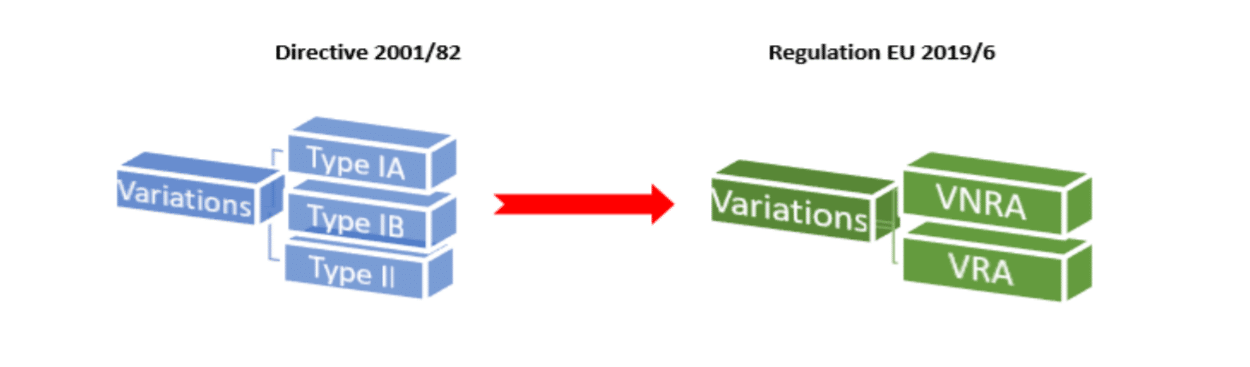
In terms of variations to marketing authorisations, one of the main changes arising from Regulation EU 2019/6 is that instead of the previous categories of Type IA, IB and II variations there will now only be two categories of variations:

  • Variations Not Requiring Assessment = VNRA
  • Variations Requiring Assessment = VRA

Vet article image 05 04 22


VNRAs consist of all the previous type IA and some Type IB variation categories.

VRAs will consist of most of the previous Type IB and all of the Type II variation categories.

Commission Regulation 1234/2008 will now no longer apply to veterinary medicinal products due to the introduction of new veterinary regulation (2019/6).

 Variations Not Requiring Assessment (VNRA)

The Implementing Regulation (EU) 2021/17*, includes a list of all variations not requiring assessment along with any associated conditions and documentation requirements and is published in the EU Official Journal here.

The variations are classified as follows:

  1. Administrative changes
  2. Changes to the quality part of the dossier
  3. Changes to the safety, efficacy and pharmacovigilance part of the dossier
  4. Changes to the vaccine antigen master file (VAMF) part of the dossier

VNRAs will be processed as follows:

  • The MAH will:

– Record the change in the Product Union Database (UPD) within 30 days of implementation including required documents (no application form is necessary).
– Documents submitted directly to UPD. No CESP submission. Documents include those listed in the Implementing Act as well as SPC, package leaflet, labels.

  • The relevant CA/RMS will

– Approve/reject the variation
– Inform MAH & CMS by recording decision in database and by e-mail

CMDv has written a Best Practice Guide for variations not requiring assessment in order to provide detailed guidance on the new process.

The EMA website includes a video tutorial showing how to submit a VNRA via the Union Product Database here.

Variations Requiring Assessment (VRA)

Every change not listed in the Implementing act mentioned above (2021/17)* will require a variation that needs to be assessed.

CMDv and EMA have written a new classification guideline for the VRAs:
Guidance on the details of the classification of variations requiring assessment according to Article 62 of Regulation (EMA/CMDv/7381/2021).

The format and categorisation is similar to the previous regulation which applied (Commission Regulation 1234/2008 ), however there are many differences.

The variations are divided into chapters as follows:

E. Administrative changes
F. Quality changes
G. Safety, Efficacy and Pharmacovigilance changes
H. VAMF or, PTMF changes
I. Changes of active substance(s), strength, pharmaceutical form, route of administration or food producing target species

Z-categories have also been included to address unlisted variations and VNRA, if requirements laid down in the Implementing Regulation are not met.

The timetable for VRAs is also outlined in the new guidance as follows:

  • a standard timetable, denoted by ‘S’ which will be 60 days
  • a reduced timetable, denoted by ‘R’ which will be 30 days
  • an extended timetable, denoted by ‘E’ which will be 90 days

For details on how to submit a VRA, CMDv have written a Best Practice Guide for Variations Requiring Assessment (EMA/CMDv/144277/2021). It has been prepared in order to facilitate the processing of VRAs for MRP/DCP products. The same general principles will apply to purely nationally authorised products.

Recommendation for the classification of variations not already listed

A procedure for requesting a recommendation for the classification of variations not already listed in either the above-mentioned Implementing Regulation or the EMA/CMDv Guidance on variations requiring assessment has also been established. This is similar to the previous CMDv recommendations for classification of unforeseen variations, according to Article 5 of Regulation 1234/2008.

Refer to CMDv new guideline for detailed advice this new process entitled: Procedural advice for requests for the classification of variations not already listed in Commission Implementing Regulation (EU) 2021/17 or EMA/CMDv Guidance on the details of the classification of variations requiring assessment according to Article 62 of Regulation 2019/6 (EMA/CMDv/144284/2021).

Worksharing and Grouping

Grouping and worksharing procedures do not apply to VNRA, they only apply to VRA.
As a consequence, no VNRAs can be included in a grouping or worksharing even if they are consequential or related to the VRAs included in the grouping or worksharing procedure.
However, the introduction section of CMDv Best Practice Guide for Variations Requiring Assessment (which also covers grouping), outlines the different approaches to follow when there is a need to co-ordinate changes that are related or consequential but are classified as VNRA and VRA.

The worksharing procedure is outlined in Article 65 of the NVR and it will be compulsory to follow this procedure, when the same change is being applied in different member states. Information related to worksharing is also mentioned in the CMDv BPG for Variations Requiring Assessment. However a specific guide on worksharing has also been written by CMDv: Best Practice Guide for Worksharing (EMA/CMDv/204024/2021).

Union Product Database

Due to the new regulation, the EMA has introduced new IT systems. The main one will be the Union Product Database (UPD).

It will contain information for all authorised veterinary medicines in the EU (including all nationally authorised products). For MAHs, it will provide self-service access for specific regulatory activities, including the management of variations that do not require assessment.

For more information on implementation, training, registration and access of the UPD, refer to the following link here on the EMA website.

The UPD will be linked to the other 3 other databases in the future. These databases are at different stages of development and introduction:

  • Union Pharmacovigilance Database

On 28 January 2022, the Union Pharmacovigilance Database (EVV) was successfully released. User guidance and the release notes are available here.

  • Manufacturing and Wholesale Distribution Database

The Manufacturers and Wholesale Distributors database (MWD) was released on 28 January 2022. The system is an enhanced and upgraded version of EudraGMDP, the EU database of manufacturing authorisations and certificates of good manufacturing practice, with changes affecting both the veterinary and the human domains. The MWD Project Group has also adopted requirements for aligning the GDP module with the change made to the system so far. Changes to the module will be delivered in a subsequent release scheduled for Q1 2022. In addition, enhanced search facilities on the GMP module will be delivered in the same release.

  • Database for the Collection of Data on Sales and Use of Antimicrobials in Animals.

IT development on the Collection of Antimicrobials Sales and Use Data (ASU) project started in January 2022. Information on the progress of this project will be published on the EMA website as this project develops.

Q&A on transitional arrangements

CMDv has prepared a Q&A document in order to assist both MAHs and NCAs in the management of the transition between the requirements of Directive 2001/82/EC and Regulation (EU) 2019/6. This Q&A document will be regularly updated and can be found under the following link.

This document includes an Annex which outlines how individual Member States will handle renewals of marketing authorisations after 28 January 2022.

Should you need any support with Veterinary Procedures feel free to contact us & the Ivowen team will be here to help.

Written by Claire Brown

Claire Brown

Request a Quote